Categories
اداریہ

Khudi Organizes National Counter-Terrorism Policy Dialogue

counter-terrorism-policyMore than 41,000 Pakistanis have been killed in terrorism related violence since 2003, including more than 2,000 casualties only in the first four months of 2012. Yet, apart from military operations in Swat and FATA, Pakistani state has not yet come up with a holistic counter-terrorism strategy;  a strategy broad enough to include counter-extremism aspect in order to counter the dangerous narratives which motivate people to commit terrorist activities. Some government initiatives such as the inception of National Counter-Terrorism Authority could not be materialized probably because of the lack of political will from the state actors.

Khudi invited experts to discuss these issues and to make recommendations as to what role the government, international community, civil society, activists and the intelligentsia can play in dealing with the multi-faceted problem of terrorism.

Khudi team explained “The Blueprint for a National Counter-extremism Strategy”, highlighting five components of the strategy:

1)      Counter-insurgency

2)      Counter-terrorism

3)      Counter-radicalization

4)      De-radicalization

5)      Integration

Lt General (R) Talat Masood, a renowned defence analyst, criticized Pakistan’s foreign policy from Afghan War onward in terms of patronizing jihad and harbingering international militants. Khawaja Khalid Farooq, the head of the National Counter-Terrorism Authority (NACTA), took a defensive stance about the failures of law-enforcement agencies, owing to the absence of a supporting legal framework.

Muhammad Amir Rana, the Executive Director of the Pakistan Institute of Peace Studies, took on the extremist narrative prevalent all over society as the primary cause of failure of counter-terrorism policy. He added that the state does not seem sincere in tackling with non-state actors and that there should be zero-tolerance for all sorts of militant organizations involved in terrorism.

Khalid Masud, former chairman of Council of Islamic Ideology, pointed to the responsibility of religious scholars in countering the spread of extremism. He said that religious scholars need to develop consensus on the justificatory paradigms behinds acts of terrorism which include issues of “Takfir” and “Khuruj”.

The talks were followed by intensive questions and answers session. But owing to complexity of the problems, great many questions are still unanswered.

Categories
اداریہ

Balochistan Dialogue

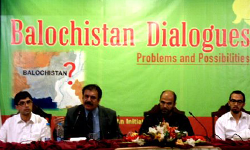
Balochistan-DialoguesIn the context of grave situation in Balochistan, Khudi organized a dialogue engaging youth from Balochistan to discuss the nuances of the problem and to make their voices heard across the country.

The event was attended by a large gathering of youth mostly from Balochistan and was chaired by Dr. Asim Sajjad Akhtar, a prominent academic for Quaid-e-Azam University. Speakers included Dr. Ishaq Baloch, senior vice president of National Party of Balochistan; Sajjad Hussain Changazi, a Hazara social activist from Quetta; and Imran Bazojai, a Pashtun student leader from Balochistan.

In his introductory remarks Dr Asim Sajjad lamented that we have been ignoring the Balochistan issue for decades which has made things worse in the region. He was of the view that the Pakistani state has always tried to suppress the ethnic, cultural and linguistic diversity in different parts of the country. The slogan of ‘one language, one nation’ greatly damaged national unity so much so that it ultimately led to the breakup of Pakistan in 1971. The way out of this contradiction between national and regional identities is to accept the differences and diversity. He feared that the coercive sate policies will yield horrible results.

Dr. Ishaq Baloch emphasized that in order to understand this complex problem correctly we need to look it in historical perspective objectively. He opined that Pakistan was not created in the name of religion. Its creation was in fact the result of denial of federalism in the united India as the autonomy of Muslim majority states was not accepted. He suggested that we need a paradigm shift in the state policies towards Balochistan if we have to resolve this problem permanently. The state will have to accept our ethnic, linguistic and cultural identity. He also added that state violence against Baloch nationalists must stop now and Baloch people should be given complete rights over their land and resources.

Sajjad Hussain Changazi underscored the need to have better communication between different ethnic groups in Balochistan. He pointed out that some elements in the establishment are trying to paint Balochistan issue as an ethnic conflict among Balochs, Pashtuns and Hazaras which is totally wrong.

He further added that more than 700 Hazaras have been killed since 2000 and Lashker-e-Jhangvi, a militant sectarian outfit, is responsible for the genocide of Shia Hazara. He chastised that the state is not doing enough to protect Hazara community form this barbarity.

Imran Bazojai said that Baloch and Pashtun are the two major stake holders in the province but the Pashtuns have always been ignored in the debate on the issue. He highlighted that if Pakistan is to survive as a viable state then it must give autonomy to its provinces. He further said that Pashtuns have always stood for rights of the Baloch and all other suppressed groups and will continue to do so in future.

Categories
اداریہ

عدلیہ اور اسلامائیزیشن

فیملی گیٹ سکینڈل نے اعلی عدلیہ میں ایک نئے بحران کو جنم دیا ہے۔ پاکستان کی تاریخ عدالتی بحرانوں سے بھری پڑی ہے۔ تاہم کچھ تنازعات دائمی شکل میں ہمیشہ موجود رہے ہیں۔ ان میں سے ایک اسلام کی آئینی اور قانونی حیثیت کا تعین ہے۔ زیر نظر مضمون میں اسی مسئلے پر اس امید کے ساتھ بات کی گئی ہے کہ اس سے ایک صحت مند بحث کو فروغ ملے گا۔
پاکستان میں مذہبی انتہا پسندی کی شکل میں تشدد اور تنازعات کا جو سلسلہ آج ہم دیکھ رہے ہیںاس کا ایک بنیادی عنصر مذہب کا دلیل کی جگہ لے لینا ہے۔ یہ عنصر نہ صرف نچلی سطح پرتشدد پسند گروہوں کی صورت میں نمودار ہوا ہے بلکہ ریاست کے اعلیٰ ترین اداروں خصوصاًعدلیہ نے بھی اس کو اپنایا ہے۔ یہ کہنا زیادہ درست ہو گا کہ عدلیہ نے اس رجحان کو معیار بنانے میں پہل کی ہے۔ قرآئن سے ثابت ہے کہ معاشرے میں قانون کی حکمرانی کے فقدان کے باوجود قانون اور عدالتی فیصلوں کا عوامی شعور کی تشکیل پر گہرا اثر ہوتا ہے۔ یہ دیکھنا ضروری ہے کہ کس طرح پاکستان کی اعلیٰ عدلیہ نے قانونی نظام میں استدلال اور آزمودہ آئینی تصورات کی بجائے مبہم مذہبی بیان کو جگہ دے کر منفی معیار تشکیل دیا ہے۔
پاکستان میں مذہب کے مفروضہ ریاستی مقام اور عدلیہ کی جانب سے اس مقام کی ٹھیکیداری کی کلاسیک مثال چیف جسٹس افتخار چوہدری کی زبانی سر زد ہوئی جب انہوں نے پارلیمنٹ کے قانون سازی کے اختیارات کو چیلنج کرتے ہوئے کہا کہ پارلیمنٹ کو ملک کو سیکولر بنانے کی اجازت نہیں دی جاسکتی۔ دراصل چیف صاحب کا یہ بیان سابقہ کئی ججوں کے ان بیانات کی بازگشت ہے جو انہوں نے مختلف آمرانہ اور ماورائے آئین اقدامات کی قانونی حیثیت کا فیصلہ دیتے ہوئے دیئے۔ جسٹس ذکی الدّین نے بھُٹو کی فوجی عدالتوں کے خلاف اور سابقہ چیف جسٹس سجاد علی شاہ نے بے نظیر کی دوسری حکومت کی معطلی کو جائز قرار دیتے ہوئے بالکل یہی الفاظ کہے تھے۔ کیا وجہ ہے کہ ہماری عدالتوں نے آمروں کو آئین اور ریاست سے ہر قسم کا کھلواڑ کرنے کی اجازت دے دی مگر پارلیمنٹ پر بند باندھنے پر مُصر ہیں۔ اسکا سادہ جواب تو عدلیہ کی جمہوریت دشمنی ہے مگرعدالتوں کی طرف سے پارلیمنٹ کے اختیارات طے کرنے کا قانونی جواز کیا ہے۔ آئین میں عدالتی نظر ثانی کی شق موجود ہے مگر اس کا دائرہ تو بہت محدود ہے۔ اصل جواز کہیں اور سے اخذ کیا جاتا رہا ہے۔ اعلیٰ عدلیہ نے ایک سے زیادہ مواقع پر خود کو خدا کا نائب اور اسکے اقتدارِاعلیٰ کا محا فظ قرار دیا ہے۔ جنرل یحییٰ کے مارشل لا کے خلاف ہونے والے مشہور مقدمے بنام عاصمہ جیلانی میں جسٹس سجاد احمد نے یہ کہا۔ اسکے بعد یوسف علی بنام پاکستان بار کونسل ٹریبیونل (PLD 1972 Lahore 404) میں ہائی کورٹ نے اس رائے کو دہرایا۔ اور ضیاالحق کے مارشل لا کو تحفظ دینے والے مقدمے بنام نصرت بھُٹو میں جسٹس انوارالحق نے یہ تک کہ دیا کہ عدالتیں مُسلم امت کے شعور کا مجسمہ ہیں۔ اس بات سے شاید یہ فیصلہ کرنا دشوار ہے کہ اس میں تضحیک کس کی ہوتی ہے، پاکستانی عدالتوں کی یا مسلم امت کے شعور کی۔
 ابتدا میںپاکستانی عدالتیں قانونی دلائل کے لیے مذہب پر زیادہ انحصار نہیں کرتی تھیں۔آئینی تاریخ کے ابتدائی دو بڑے فیصلوں مولوی تمیزالدین اور دوسوکیس میں غیر جمہوری اور غیر آئینی اقدامات کو غیر مذہبی دلائل سے جواز فراہم کیا گیا۔ جو اس بات کی نشاندہی کرتے ہیں کہ جمہوریت دشمن فیصلے لازمی طور پر اسلامی دلائل سے اخذ نہیں ہوتے۔ اسی طرح بعد میں عاصمہ جیلانی مقدمے میں اس کے برعکس اسلامی دلائل کی بنیاد پر مارشل لا کو غلط قرار دے کر مثبت مثال پیش کی گئی۔ مگر پھر کیوں اسلام ہی کی روشنی میں ضیاالحق کے مارشل لا کو عین قانونی واسلامی قراردیاگیا۔ نہ صرف یہ بلکہ انیس سو نوے کی دہائی میں پارلیمانی روح کے خلاف صدارتی اختیارات سے حکومتیں گرانے کو بھی مذہب سے بنیاد فراہم کی گئی۔ اور پھر اسی دوران دیئے جانے والے فیصلوں کی سند سے ہی پرویز مشرف کے ماورائے آئین اقدامات جائز قرار پائے۔ اس معمے کی جڑیں پاکستان کے آئینی وسیاسی فلسفے کے ایک بنیادی تنازعے میں پیوست ہیں۔ وہ ہے اقتدارِاعلیٰ اور قانون کے ماخذ کا سوال۔ روایتی طور پر اس بارے میں د و رائے پائی جاتی ہیں۔ پارلیمانی نظام میں پارلیمان کو مقتدرِاعلیٰ سمجھا جاتا ہے جبکہ اس پر اعتراض یہ ہے کہ ایسا صرف خصوصی طور پر بر طانیہ میں ہے جہاں تحریری دستور موجود نہیں۔ لہذا دوسری رائے رکھنے والوں کے نزدیک تحریری دستور رکھنے والے ممالک میں دستور ہی مقتدر ہے۔ دونوں صورتوں میں ایک واضح معیار سامنے آجاتاہے جس کی بنیاد پر کسی اقدام کی آئینی حیثیت کو پرکھا جاسکتا ہے۔ پاکستان میں تحریری دستور اور پارلیمنٹ دونوں کے ہوتے ہوئے بدقسمتی سے جبر اور سازباز کے ایک لمبے سلسلے کے بعد ایک تیسرے میعار کو جگہ دی گئی ہے اور وہ ہے مذہب کے بارے میں مبہم تصورات۔ ٹھوس صورت میں اس کا اظہار قرار دادِمقاصد ہے۔
سادہ لوح عوام اور سیاستدانوں کا ایک بڑا حصہ شاید اسے ایک مسئلے کے طور پر نہیں دیکھتامگر اوپر بیان کیے گئے آئینی بحرانات قرار دادِ مقاصد اور مذہبی تعویلات کو واضح قانونی نظام کا متبادل سمجھ لینے کی غلطی کا منطقی نتیجہ ہیں۔ تاہم اس سے پیشتر بھی کئی سوالات اٹھائے جاسکتے ہیں۔ مثلاًقراردادِ مقاصد کافی سازباز کے بعد لائی گئی،کسی اقلیتی رکن اسمبلی نے اسے منظور نہیں کیا تھا، حتیٰ کہ منظور ہو جانے کے بعد بھی اسکا مقصد پاکستان کی آئینی بنیاد مہیا کرنا نہیں بلکہ آئین سازی میں محض رہنمائی کرناتھا۔ اسکے بعد یہ ہمیشہ آئین کا ابتدائیہ رہی جو آئین کا ناقابلِ عمل حصہ ہوتا ہے یہاں تک کہ ضیاالحق نے اسے آئین کا مکمل حصہ بنا دیا۔ شاید ضیا کے وقت عدالتیں اس قرارداد کی اصل حیثیت سے واقف تھیںیہی وجہ ہے کہ سپریم کورٹ نے ضیاالحق کی آئین شکنی کو قراردادِ مقاصد کی بجائے نظریہ پاکستان کا جواز فراہم کرنا زیادہ مناسب سمجھا۔ لیکن دیگر فیصلوں میں قرارداد کو آئین کی بنیاد بنانے کا ایسا رجحان پیدا ہوا کہ کئی سنجیدہ قانونی پیچیدگیوں پر منتج ہوا۔ جس سے باہر نکالنے کی عمدہ کوشش چیف جسٹس نسیم حسن شاہ نے 1991 ء کے حاکم خان کیس میں کی۔ انہوں نے مدلل اور واشگاف الفاظ میں کہا کہ قرار داد کسی بھی طرح آئین کی بنیاد یا اس سے برتر نہیں۔ لیکن بعد کے فیصلے اس اصول کی نفی کرتے رہے ہیں۔ اصل نقطہ یہ ہے کہ سوالات اور تنازعات میں گھری ایسی دستاویز کو آئین کی بنیاد  کیسے قرار دیا جا سکتا ہے۔ یہ تو آئینی بنیاد کی بنیادی صحت پر ہی پورا نہیں اترتی۔
بعض مواقع پر قراردادِ مقاصد کو بظاہر جدت کے ساتھ بنیادی ساخت کے نظریے میں لپیٹ کر پیش کیا جاتا رہا ہے۔ موجودہ جمہوری نظام کے قابلِ ستائش کارنامے یعنی اٹھا رویں ترمیم کو بھی بنیادی ساخت کے نقطہ اعتراض پر کٹھائی میں ڈالنے کی کوشش کی گئی۔ بنیادی ساخت کے نظریے میں جمہوریت، پارلیمانی ووفاقی نظام، عدلیہ کی آزادی اور ان سب کے ساتھ اسلامی امتزاج کو شامل کیا گیا ہے۔ بنیادی ساخت کے ہر ذکر میں ’اسلام کا امتزاج‘ آخر میں آتا ہے مگر جب بھی کوئی تضاد سامنے آتا ہے تو یہ امتزاج ایک ایسی سرحدی دیوار ثابت ہو تا ہے جو بنیادی ساخت کے باقی جملہ لوازمات کو آمرانہ روی کے قلعہ میں مقید رکھتا ہے۔حاکم خان کیس میں ہائی کورٹ نے سیاسی قیدیوں کی رہائی کو غیر اسلامی قرار دیامگر سوال یہ ہے ان سیاسی کارکنوں کی قیدوبند کی اسلامی دلیل کیا ہے، اگر ہے تو کیا وہ قابلِ قبول ہوسکتی ہے۔ مشرف آمریت کو چیلنج کرنے والے مقدمے ظفر علی شاہ بنام پرویز مشرف میں عدالت نے کہا کہ مشرف آئین تو بدل سکتا ہے مگر آئین کی بنیادی ساخت نہیں۔ نتیجتاً آئین تو آئین مشرف نے ملک کا حلیہ ایسا بدلا ہے کہ اس کی شناخت مشکل ہو گئی ہے۔ آمریت کے اس سرٹیفکیٹ پر دستخط کرتے وقت عدلیہ نہ جانے کون سی بنیادی ساخت کو محفوظ رکھنا چاہ رہی تھی۔جسٹس شمیم حسین قادری کو بھُٹو کے جزوی مارشل لامیں بنیادی ساخت کی خلاف ورزی صرف اسی صورت نظر آئی کہ اس میں نافذ کرفیو مسلمانوں کو مسجدوں میں نماز ادا کرنے کے لئے کافی وقت نہیں دیتا۔
عدلیہ کی ’مذہب پسندی‘ کا ایک اور خطرناک مظاہرہ 1991 ء میں نواز شریف کے دورِ حکومت میں منظورکردہ قانونِ شریعت کے خلاف جسٹس تنزیل الرحمن کے اس فیصلے کی صورت میں بھی ہے جس میں انہوں نے شریعت ایکٹ کی اس شق کو غیر اسلامی قرار دے دیا جس میں پارلیمنٹ اور موجودہ سیاسی نظام کے وجود کو عدالتی نظرِثانی سے مستثنیٰ قرار دیا گیا تھا۔ تو گویا جس نظام کے تحت عدالتیں وجود میں آئیں، سپریم کورٹ اسی کے انکار کوجائز سمجھتی ہے۔ کیا یہ بالواسطہ طور پر اپنے ہی وجود اور اس کے جواز کا انکار نہیں؟ چنانچہ وہ کون ساصحیفہ ہے جوایسے غیر نمائندہ ججوں کو ملک کا نصب العین طے کرنے کا اختیار دیتا ہے جن کی قانونی عقل اور عوام سے وفاداری پر واضح سوالیہ نشان ہیں۔
اسلامی دلائل کی بنیاد پر انسانی حقوق اور عوامی فلاح کے حق میں بھی کئی فیصلے بھی دیئے گئے ہیں ۔ لیکن اس بات کی وضاحت کون کرے گا کہ زرعی اصلاحات، عائلی قوانین 1961 ء، مزارعین کا حقِ شُفہ اور قانون تحفظِ نسواں2006ءکیا انسانی حقوق کے مسئلے نہیں؟ اقلیتوں کے حقوق کی دلالت کہیں نظر کیوں نہیں آتی؟ہر قسم کے مسئلے پر’سو موٹو‘ اختیارات کو استعمال کیا جاتا ہے مگر مذہب کے نام پر تشدد کرنے اور تشدد پر اکسانے والوں کے خلاف کیوں نہیں؟ نقطہ مقصود یہ ہے کہ عدالتیں اسلام کا منتخب استعمال کرتی ہیںجس کا بنیادی مقصد قراردادِمقاصد اور بنیادی ساخت کے عدالتی دائرہ اثر کے ذریعہ حتمی طور پر اپنے اختیارات کو بڑھانا ہوتا ہے۔ کسی بھی قانون کو مسترد کرنے کا یہ اختیار اور اس سے جنم لینے والی غیر یقینی کیفیت قانونی نظام کی بقا کے لیے خطرہ ہے۔ اس عدالتی آمریت سے چھٹکارہ نہ پایا گیا تو انتہا پسندی کو فروغ ملے گا اور جمہوری امکانات کی روشنی بجھتی جائے گی۔
Categories
گفتگو

In Conversation with Mohammed Hanif

hanif, mohammedMohammed Hanif rose to fame as a novelist with ‘The Case of Exploding Mangoes’ and ‘Our Lady of Alice Bhatti’. He is also a journalist currently working with BBC Urdu. Hanif is a leading voice in Pakistani fiction.


Laaltain: You write very good Urdu prose, why do you choose to write your novels in English?

Mohammed Hanif: I write in Punjabi as well but most of the novels I have read happen to be in English, though I read Urdu as well. Even if they are Russian, Spanish or any other language, we read them in English translations. So one’s mind is full of writings in English. It’s like, if you are growing up listening to rock music, chances are if you start your own band, you will choose to produce rock music.

Laaltain: Apparently “The Case of Exploding Mangoes” was received better by readers but, as you said in one of your interviews, it is “Our Lady of Alice Bhatti” in which you really spoke your mind. Why did “Alice Bhatti” not receive as good a response?

Mohammed Hanif: I don’t know… actually lots of people have said lots of nice things about “Alice Bhatti”, people have different tastes. I think we are a very politicized society, we meet friends who love conspiracy theories and power politics; maybe that’s the reason people like “Exploding Mangoes” more.

Laaltain: In all your writings, not just novels, you maintain this tone of distance, indifference, and satire when it comes to characters and situations. How did this characteristic develop in you?

Mohammed Hanif: I think it comes from what you have read and what you like from what you have read. I think I have read things which influenced me, and that’s how I ended up writing like this. There is no one incident which can explain this. It is all of your life experiences and your readings which go into shaping what you become.

Laaltain: You once said that a fiction writer has no social responsibility but in your first novel you mocked a dictator while in the second you empathized with a poor Christian woman; all this seems socially and politically very relevant.

Mohammed Hanif: I think it’s the subject you are interested in which takes you somewhere. I am interested in politics but when I am writing a piece of fiction, I care about the politics of my characters. Where they come from, which class they belong to etc. And that automatically gives them a certain kind of outlook of the world. I am deeply interested in that kind of politics. But I am not interested in making grand statements. That’s why I don’t sit down to write novels to change anything or try to be somehow a responsible citizen. No, that’s not the case as a writer; but as a journalist I have that duty.

Laaltain: Would you like to comment on the abrupt and tragic ending of “Alice Bhatti”?

Mohammed Hanif: No, I really find it difficult after I have finished writing something because the process is quite long and painful. After I have written it, I can’t really explain it. My job is to write the book and it is other people’s job to comment on it.

Laaltain: How do you manage being a writer as well as a journalist – two jobs which demand somewhat different approaches?

Mohammed Hanif: Actually, I don’t have an intensive journalistic job any more. In a way it is good, if done properly I think they can complement each other.

Laaltain: What is it that you like most about the process of writing fiction?

Mohammed Hanif: Finishing (laughs). You start with vague ideas, voices, and images but during the process of writing – and it happens very rarely, once a year may be – suddenly there is a moment when things become clearer; suddenly you see something which you had not seen before and that does not happen just by thinking, it happens during the process of writing. Sometime, you take a turn without knowing and suddenly you are where you wanted to.

Laaltain: Through small incidences and situations in your writings, you often describe the bigger realities of Pakistan. How did you develop such deep insight into society?

Mohammed Hanif: I don’t think I have very deep understanding but what I like doing is, I keep my ears open. I don’t always hang out with journalists and writers…. The way people speak tells you a lot about them and their stories. So I think some of that might reflect in what I write. I just listen to people and then imagine what they would be like.

Laaltain: Coming from a humble, rural background, you have become an international figure, how does it feel?

Mohammed Hanif: Actually it happened quite slowly, you spend years and years writing something, then it takes a couple of years to get it published and by the time it comes out you are already into something else. It feels good sometimes. Sometimes I feel lucky because there are many brilliant writers out there and they have to struggle a lot more than I have.

Laaltain: How do you see the future of Pakistan in terms of literature and culture?

Mohammed Hanif: I don’t really know. There are many learned professors who are better suited to answer this. I am not totally pessimistic, there are bad days and then there are good days as well when I feel slightly optimistic.

Laaltain: Anything that made you optimistic recently?

Mohammed Hanif: That is a good question…um sometimes the weather is quite good. One day, last December, I went to the Karachi beach. It is usually very filthy, but that day it was absolutely clean and there were thousands of white birds everywhere. I don’t know where they came from, probably from Siberia. That was a perfect day.

Laaltain: Any message for a young Pakistani or any potential reader of this interview?

Mohammed Hanif: Read…. whatever they want to read.

Laaltain: Anything that you would like to recommend?

Mohammed Hanif: I am reading Ismat Chughtai these days. She is absolutely brilliant. She should be read in schools.

Categories
نقطۂ نظر

‘Good looking Jamaat-e-Islami’

The Jamaat-e-Islami (JI) has significant influence in Pakistan’s domestic politics due to its strong representation in the media, its ability to show street power and its connection with both the security establishment and militant outfits. However, as far as its vote bank is concerned, it hasn’t done too well. The main reason for this could be that the JI carries the tag of Deobandi Islam, which most Pakistanis do not follow. Another reason is that although the general public is very narrow-minded and conservative in its religious outlook, it is very liberal and secular when it comes to personal lifestyle. It wishes death on ‘kafir’ (infidel) India; but will not stop watching Indian movies. It likes to hate the USA with a passion; but craves an Americanized way of living.

Both Pakistan’s establishment and the JI have felt the need to have a front organization with a moderate semblance for quite some time now – one which has the potential to win popularity in the masses. This desire was reflected in the JI’s creation of Pasban in the early 1990s. Its name was changed to Shabab-e-Milli when Pasban was banned in 1995 after its involvement in violence. Apparently, these were independent organizations; yet it was too obvious that they were JI protégés. The public postures of these organizations leaned more towards nationalism than Islam. To arouse enthusiasm, patriotic songs were played with music in Pasban’s rallies, which was against the traditional JI culture. The Cricket World Cup victory of 1992 was celebrated by Pasban all over Pakistan by holding Junaid Jamshaid’s ‘Pepsi-Pakistan’ concerts. Pasban was publicised in all possible ways. It, however, lacked a leader possessing the magnetism necessary to attract the public. Both the JI and Pakistan’s deep state were looking for a charismatic character like Jinnah and ZA Bhutto – someone who had the glitz of Western culture but a mindset of an Islamist. One senior JI member who had previously been the nazim of the Islami Jamiat Talaba (IJT) at Punjab University, Hafeez Ullah Niazi found the right person for this job. Niazi happened to be the brother-in-law of the cricketing super star, male sex symbol and Casanova of international repute, Imran Khan.

JI’s early nurturing of Imran

It was easy for Hafeez Ullah to preach Maudaudi’s Islamic ideology to Imran, who, after enjoying the best of this world was perhaps seeking the same for the next world.

Imran retired from cricket first in 1987, after his team’s defeat in the World Cup semi-final at Lahore, but reversed his decision at the insistence of General Zia ul Haq. After winning the 1992 World Cup as captain, he attained the status of a national hero, after which he finally hung up his cricket shoes. A series of articles written by Imran from 1987 to 1992, in which he criticised western culture and the British Empire and emphasised the promotion of one’s own Islamic-nationalistic identity, reflected the JI’s brainwashing. The JI had got hold of Imran in the early stages of his reversion to his native culture.

Imran, who wished to remain in the public eye even after retiring from cricket, started building a non-profit cancer hospital in Lahore. Pasban helped him in organizing the fundraising campaign for this purpose. Here, another double standard of the JI was exposed. Since the mid 1980s, Pakistani artists had been performing in shows in India. In return, event organizers in Pakistan tried to invite Indian artists to Pakistan. However, all such events had to be cancelled due to vociferous threats by Pasban. But in 1995 when Imran invited Indian movie stars such as Rekha, Vinod Khanna, Sonu Walia and Kabir Bedi to perform in Lahore for the fundraising of his hospital, Pasban did not object even a bit.

Similarly, JI has always slandered its rivals by finding faults in their personal lives. For instance, in the 1970s it targeted the ‘un-Islamic life style’ of ZA Bhutto. In public speeches and in slogans, it called Bhutto “sharabi” and “za’ni” (alcoholic and adulterer). However, Imran’s colorful life never bothered the JI. In the case of Bhutto, the JI went as far as to allege that his mother was a Hindu. When in 1994 Imran, the critic of Western culture and British aristocracy, married a woman from a British Jewish elitist background, JI did not even raise an eyebrow.

Making of PTI under JI’s fostering

Imran’s links with the JI are too obvious. Initially JI’s Qazi deployed its expert campaign designers along with two of Pasban’s founding members – Shabbir Sial and Mahmood-ur-Rasheed (elected as member of the Punjab Assembly on a JI/IJI ticket in 1988) – to help Imran organise his campaign for the 1997 election. The JI itself boycotted that election. Sial later served PTI as its president in Lahore, a position now held by Rasheed.

Ejaz Chaudhry, PTI’s vice president and incharge youth affairs, considered to be Imran’s closest adviser, is ex-JI and son-in-law of Maududi’s immediate JI successor, Mian Tufail Muhammad. Another VP of PTI, Abdul Hafeez Khan, is an ex-IJT nazim of Punjab University.

Since its inception, PTI’s governing body has been populated by ex-members or sympathizers of the JI. Usually, two parties develop a rivalry if members of one are snatched by the other. But in this case, JI members joined the PTI on the behest of JI, under an orchestrated infiltration of an up and coming party. Not only was Imran quick to forgive the IJT when its workers manhandled him at Punjab University in 2007, but the person he appointed as chief of PTI’s student wing (ISF), Ehsan Niazi, is also ex-IJT. Students running from the IJT because of its hoodlumism and joining the ISF will again find themselves under an ex-IJT man.

As elections draw near, the growing popularity of the PTI will attract opportunists from all political backgrounds. However, PTI will most likely retain its core group that has JI’s ideology deep-seated in its heart and mind.

PTI connections with Jihadists

During 1995-1996, just before the launch of PTI, Imran had numerous meetings with General Hamid Gul. Newspapers of the time were full of speculations that Imran and Gul were jointly launching a party to provide an alternative leadership to those fed up with bipartisan politics. This did not happen, probably to avoid the exposure of Imran’s close links with former members of the security establishment who were still close to Jihadi outfits.

However, Lt. General Mujeeb-ur-Rehman, who had served as secretary information during Zia-ul-Haq’s regime and was said to have close links with the security establishment, was one of the founding members of PTI and went on to become its secretary general. It is also worth noting that in 1997, soon after the launch of PTI, Imran toured Chechnya where, for one week, he was the guest of the president of Chechnya, Mujahideen rebel leader Aslan Maskhadov, who later instituted full sharia law in Chechnya.

Furthermore, PTI’s soft, apologetic stance on the Taliban issue is a well-known fact. Imran has been opposing military operations against the Taliban and trying to justify the movement as a “Pushtoon nationalist resistance against occupation forces”. He has been one voice with Islamist parties on the issues of war on terror, drone attacks, Aafia Siddiqui, Raymod Davis etc.

Imran’s right hand man, Ejaz Chaudhry, has close links with fanatic sectarian organizations like Sipah-e-Sahaba Pakistan. Chaudhry actively participated in the rallies of another extremist organization, Aalmi Majlis Tahaffuz KhatmeNubuwwat, notorious for its extreme hatred and incitement to violence against Ahmadis. Chaudhry took the podium at a rally held by them in favour of Mumtaz Qadri (the self-confessed killer of Salmaan Taseer) where he declared that he spoke for Imran Khan when he said that the blasphemy law is a godly law that no one should dare touch. Moreover, his discourse on the alleged involvement of the CIA and RAW in the PNS Mehran attack is identical to TTP-SSP-LeJ-JI rhetoric.

When in 2007 Imran was arrested protesting against the declaration of emergency by General Musharraf and detained in D.I. Khan Jail, the then TTP President Baitullah Mehsud threatened to blow up the jail if Imran was not released. His statement appeared in all leading newspapers and Imran was released within 24 hours. Later on October 02, 2008 when Mehsud made a public appearance in South Waziristan, local president of PTI Toofan Burki garlanded him and put a traditional pagri (turban) upon his head.

Another PTI member, Shireen Mazari (also known as ‘Lady Taliban’), who is its spokesperson and adviser on foreign affairs, is known for her advocacy of conspiracy theories in the media. She writes a regular column for the website run by Ahmed Quraishi (who gives Zaid Hamid a run for his money in promoting baseless theories to blame atrocities and actions of the Taliban on others). Mazari is said to have close connections with the security establishment. She is a regular lecturer at the National Defense College where her specialized subject is Islamic ideology. If the curriculum of the ‘educational revolution’ that Imran Khan wants to bring in Pakistan is going to be designed by likes of Mazari, then our schools will produce more Taliban than even madrassas do.

Will PTI deliver?

In his recent rally in Lahore, Imran Khan said nothing new but pushed the single-point thesis of the establishment in which all the problems of the country are attributed to the corruption of the politicians. This is the agitprop that the deep state of Pakistan has been amplifying through the media since the restoration of the democratic system in 1988 and on the pretext of which many elected governments were dismissed halfway through their mandated period. Imran has strengthened the belief of the common man that corruption really is the actual cause of all his miseries, which is only a small part of the truth. The hyperbole of this overstatement has always been aimed at playing down and concealing the root cause of the country’s actual distress, which in fact is the jingoism and martial plans of our establishment. The establishment is eating up our country’s limited resources and, along with the bigoted mullahs, is the major obstacle to our nation’s progress. Imran Khan represents both these elements.

This disparate nation is once again seeking a remedy for its problems from the source of the problem itself. If Imran Khan now has the cure of the problems of the country, then the JI had it all along. In that case, the people of Pakistan were fools for not electing the JI a long time ago.

Categories
نقطۂ نظر

Death of a Nathu

Nathu died yesterday.

He was found on a street in the premises of the Faisalabad district courts. His clothes were in shreds and shoes torn. A scroll of paper was stuck under his armpit and flies were buzzing all around him. Seeing his dead body reminded me of a day, four years ago, when he almost fainted in front of my chamber and I rushed to bring him water. He told me that he was deprived of his shop by local authorities almost six years ago and even though the Lahore High Court had said that he be paid in cash or in property as compensation, he had received nothing.

He said he had used up every single penny at his disposal – and went to the extent of not paying his kids’ school fees – to meet the expenses of lawyers, clerks and lower judiciary (readers, stenographers) for contesting his case. But he was no closer to getting his due. I asked him why he hadn’t filed a fresh appeal for the implementation of the orders of the Lahore High Court.

He liked my proposal and did as I told him. Over the next few months, I didn’t see or hear from him. One day, with a glow on his face and marks of a tired but victorious athlete, Nathu said a loud slamalekum to me and broke the happy news that the Lahore High Court had taken notice of the non-cooperation/non-compliance of the authorities concerned and ordered for quick action. The time limit, Nathu added, was four months. He even offered me a cup of tea from his own pocket, such was his ecstasy.

Nathu was incorrigibly optimistic but the time limit was ending and nothing was happening. One could tell his patience was waning but Nathu was Nathu. Unlike most Pakistanis, even after having been duped by the local administration and witnessing the treatment meted out to him by different levels of lower judicial staff, he was still waiting for a chhakka on the very last ball.

The signs of anxiety appeared on his face again immediately after the sacred four months were over. “How can this happen? Why doesn’t the city nazim take any action? Why don’t the officials concerned give any consideration to the injunctions of the superior judiciary? What should I do now?” He let loose a barrage of questions which were simple to ask but difficult to answer. Signs of fatigue and exhaustion were quite prominent on his face. How should I tell you what he was looking like?

Have you ever seen a woman who undergoes the unbearable pangs of childbirth but is deprived of catching even a glimpse of her baby? Have you ever seen a gardener who waters, cuts, trims and prunes a plant and when one day, after many years, the tree bears fruit, the gardener is deprived of the right to enjoy them? Have you ever seen a man with a bundle of dog-eared papers on which is the verdict of the supreme judiciary on his behalf, but even after months of waiting, justice evades him?

Your reaction will definitely be that this is sheer injustice and below all norms of common sense and equity. But this is a common phenomenon in any court in Pakistan. As a student of law, I bear witness to hundreds of distressed people who carry files and files of papers with them, not knowing where to go and whose door to knock on for the implementation of verdicts in their favour. If you are a petitioner, you have no chance of justice if the party against you has any link with the government, be it federal, provincial or local. In Pakistan, the decisions passed in favour of the poor remain unimplemented and the decisions taken against the rich remain unimplemented. It is common to see the less-privileged crying for the execution of decisions made decades ago in their favour; and after they are gone their children and grandchildren continue to do the same, but nothing ever happens.

What is the value and effectiveness of a verdict passed by the judiciary if it is not implemented? I would like to bring the attention of certain people to this matter: the president and prime minister of the Islamic Republic of Pakistan; the chief justice of the Lahore High Court; the banner holder of suo-moto actions, Chief Justice of Supreme Court Iftikhar Chaudhry; Chief Minister of the Punjab Government Shahbaz Sharif; and the D.O. Faisalabad – not in the capacity of an advocate but as a very common citizen. How can the procedure of justice be consummated if people like Nathu, who constitute almost 85% of the population, are trampled upon and neglected?

Sometimes I think that Pakistan is a place of wonders where people with no land become proprietors of lands overnight, and people like Nathu are not even given a rightful share of their own belongings. Had this incident happened in India with a Muslim, a furor would have been raised. But I think that Nathu should be overlooked as he is a worthless man. It would be out of place if I mention how he paid for the expenses for litigation by selling his wife’s jewellery and his son’s tricycle. Let Nathu go to hell! Why should I worry about him?

Categories
خصوصی

Celebrating Inspirational Pakistani Women

Here is a list of some of the great Pakistani women who have not only struggled to make their own lives but have also changed for good the lives of many people around them and eventually the image of Pakistan. We are proud of them and their legacy.

The list is not at all exhaustive but just an overview to show the strength of the Pakistani woman.

Ameena-SaiyidAmeena Saiyid

– for running the most prestigious publishing organization; for reviving reading habits and love for books among children and adults alike and for launching Pakistan’s biggest literature festival that is fast turning into a tradition!

Asma-JahangirAsma Jahangir

– for obliterating the tycoons of corruption and misery in Pakistan and for giving a voice to countless women who had lost hope and meaning of life

Atiya-Fyzee-RahaminAtiya Fyzee Rahamin

– for being a leading patron of art, culture, music and literature and for being an accomplished artist and poet herself who chose to settle in Pakistan after partition at the request of Mr. Jinnah

Attiya-DawoodAttiya Dawood

– for writing bold and rebellious poetry highlighting the plight of women, discrimination they face at the hands of men in the society and the crimes that are perpetrated against them!

Ayesha-JalalAyesha Jalal

– for being one of the most outstanding and internationally acclaimed historians Pakistan has produced so far

Begum-Ra'ana-Liaquat-Ali-KhanBegum Ra’ana Liaquat Ali Khan

– for being one of the earliest women politician and social worker in Pakistan; for being the first female Governor of a province and Chancellor of a University; for founding APWA, oldest and leading organization for welfare of women in the country.

Benazir-BhuttoBenazir Bhutto

– for being the first woman Prime Minister in the modern Muslim world and for fighting dictatorship without fear of her life

Balqees-EdhiBilquis Edhi

– for silently, humbly striving to take Edhi and its work forward

Bushra-GoharBushra Gohar

– for being a leading human rights activist and politician from the conservative Khyber Pakhtunkhwa province and for championing the cause of women inside and outside parliament

Diep-SaeedaDiep Saeeda

– for fearlessly fighting bigotry, extremism and persecution of the poor and helpless by always taking the front lead; for her exemplary courage and valor

Dr-Farzana-BariDr Farzana Bari

– for her outstanding contribution to gender studies and for being a vocal women’s rights activist

Dr.-Attiya-InayatullahDr. Attiya Inayatullah

– for her lifelong contribution to family planning/population welfare and for being the only Pakistani woman to serve on the executive board of UNESCO and head the organization

Dr.-Ayesha-SiddiqaDr. Ayesha Siddiqa– for her bold stance against the military; yet sustaining it
Dr.-Fauzia-SaeedDr. Fauzia Saeed– for her contribution as a social scientist & researcher and a leading women’s rights activist
Dr.-Maliha-LodhiDr. Maliha Lodhi

– for her outstanding contribution as a journalist, editor and later as a diplomat when she served as Pakistan’s top diplomat to US and UK

Dr.-Quratulain-BakhteariDr. Quratulain Bakhteari

– for her tremendous community services in the areas of health care, education and social activism especially in Balochistan where she established thousands of schools for girls

Dr.-Ruth-PfaoDr. Ruth Pfao

– for dedicating her life to fighting Leprosy in Pakistan and being instrumental in containing the disease in the country

Dr.-Shamshad-AkhtarDr. Shamshad Akhtar

– for being the first female Governor, State Bank of Pakistan; for her outstanding contribution as economist who served on senior positions at World Bank and later at the Asian Development Bank.

Fahmida-RiazFahmida Riaz

– for daring to say no to the patriarchy and writing rebellious poetry that forced her to go into exile during General Zia’s era

Faryal-GoharFaryal Gohar

– for being a leading human rights activist and a feminist writer who earned accolades nationally and internationally

Gulzar-BanoGulzar Bano

– for being one of the first women to serve in the bureaucracy and being the first woman Cabinet Secretary; for being one of the foremost Pakistani women poets in English

Hina-JilaniHina Jilani

– for fearlessly fighting cases of helpless women subjected to worst discrimination in the patriarchal society

Jennifer-MusaJennifer Musa

– for dedicating her life to serving the downtrodden and underprivileged in Balochistan that earned her the title ‘Queen of Balochistan’

Justice-(Retd)-Majida-RazviJustice (Retd) Majida Razvi

– for being the first woman to rise to the position of judge in a high court in Pakistan and for advocating repeal of Hudood Ordinances while she headed National Commission on Status of Women

Kishwar-NaheedKishwar Naheed

– for writing the poetry of rebellion daring age-old anti-women traditions and customs

Madiha-GoharMadiha Gohar

– for earning international acclaim for her theatrical performances and using her Ajoka theatre group to highlight social issues and promote social causes

Maj.-Gen.-(Retd)-Shahida-MalikMaj. Gen. (Retd) Shahida Malik

– for being the first woman to rise to the rank of a General in Pakistani army

Marvi-Sirmed Marvi Sirmed

– for taking a bold public stance against bigotry and religious extremism and bravely fighting for injustices and oppression at all forums

Maryam-BibiMaryam Bibi

– for her outstanding contribution to improve the status of women at grassroots level in Khyber Pakhtunkhuwa through Khwendo Kor, an organization she founded in 1993 and that works in over 300 cities and towns focusing on social organization, community-based female education, microcredit, primary health care and advocacy.

Mukhtara-MaiMukhtara Mai

– for fighting alone, and then together, against abuse and sexual violence against women

Prof.-Anna-Molka-AhmedProf. Anna Molka Ahmed

– for being a pioneer of fine arts in Pakistan and for setting up department of fine arts in Punjab University which evolved into a centre of excellence in fine arts and produced many noted artists

Rashida-Mohammad-Hussain-PatelRashida Mohammad Hussain Patel

– for her lifelong commitment to emancipation and protection of legal rights of women in her role as a leading lawyer; for founding Pakistan Women Lawyers Association that has provided legal aid to countless women

Seema-AzizSeema Aziz

– for establishing Care Foundation, a leading non-profit organization providing education to over 100,000 children in marginalized communities

Sharmeen-Obaid-ChinoySharmeen Obaid Chinoy

– for making meaningful documentaries highlighting real issues faced by Pakistan and for bringing home the first Oscar Award won by any Pakistani

Sheema-KermaniSheema Kermani

– for her grace and the lead glory on the stage that mesmerizes 100 a hearts at a time; for relentlessly fighting for women’s rights and empowerment

Sherry-RehmanSherry Rehman

– for her noted contribution as a journalist and later as a parliamentarian and a vocal women’s rights activist who tabled various bills in the assembly to empower women and protect them from discrimination and harassment

Tahira-AbdullahTahira Abdullah

– for boldly facing tyranny and bigotry and fighting for women’s rights

Tahira-Mazhar-Ali-KhanTahira Mazhar Ali Khan

– for her struggle spanning over 60 years for the rights of the underprivileged, including workers, peasants and women

Zaibunnisa-HamidullahZaibunnisa Hamidullah

– for being a pioneer of English journalism and feminism in Pakistan, for being the first woman columnist, editor, publisher and political commentator

Zubeida-MustafaZubeida Mustafa

– for her outstanding contribution to English journalism that spans over four decades; and for writing highly valuable books


—Written by Junaid Zubairi

Categories
تبصرہ

Between Clay and Dust

clay-and-dustNovelist Musharraf Ali Farooqi is out with a new book called “Between Clay and Dust”, the drafts of which he laboured over for ten years.

The cover is intriguing enough on its own, showing a man covered in dust – making one wonder if he is caught in a dust storm or has just emerged from the earth.

However, the contents of the book throw light on the cover. The story revolves around a wrestler Ustad Ramzi and a courtesan Gohar Jan – both proud, ambitious and well-known in their heyday – who are now dealing with the struggles of growing old as they try to come to terms with modern times and the changes that Partition has brought to their unnamed town. The town is simply called the Inner City, leaving the reader to make his or her own decision about whether the book is based in India or Pakistan.

It is, in Farooqi’s own words, a story about “two people faced with similar challenges… one of them is able to make good choices within that situation and the other is not.” It is also “a love story, and a story about missed chances and redemption.” In words of renowned Indian film star Naseeruddin Shah:

“A privileged peek into the mind of the Pahalwan and Courtesan, the Subcontinent’s most intriguing symbols of romance. Storytelling at its best.”

The two main characters face dual challenge of losing their age and vigor, and the changing social norms. The prospect of diminishing relevance brings shattering consequences for them who were habitual to admirers from a wide social circle. Through these challenges Farooqi has constructed a penetrating study of human nature in terms of honor, love, redemption and strength. The book is worth reading for both its gripping story and its “spectacular imagery”.

Farooqi is a man of many talents; he also writes children’s’ books and is well-known for translating Dastan-e-Amir Hamza into Urdu. His earlier novel “The Story of a Widow” has been shortlisted for South Asian Literature Award 2010. “Dust” is already being critically acclaimed on both sides of the border for “telling a story fraught with emotionality” and telling it well.

Categories
نقطۂ نظر

Why Balochistan is Burning

Located at the heart of the world’s oil route and with 750 km of highly strategic Arabian Sea coastline, Balochistan is the largest province of Pakistan, with the smallest number of people. Accounting for 44% of Pakistan’s landmass, this Texas-sized province constitutes merely 5% of the country’s total population. It is the least developed and the most impoverished province, where socio-economic realities paint a somber picture.

BalochistanThe province has been a hotbed of insurgency since the creation of Pakistan. The Baloch ethno-nationalist movement, which started in response to colonial encroachments and gradually thrived in post-colonial Pakistan in response to the highly centralized power structure of the country, poses a serious challenge to the integrity of Pakistan. Currently, an insurgency is underway that may have vast and diverse implications not only for Pakistan and other regional players but also for the global ‘war on terror’.

Though the movement has been striving for securing equal rights and achieving regional autonomy within a restructured federal framework, over the years separatist feelings have intensified, leading some elements to seek complete independence from Pakistan. Pakistan’s over-centralized state system, weak federal structure, unresponsive political institutions and lengthy dictatorial rule, all have given birth to feelings of alienation and marginalization among the Baloch. Protracted military rulers not only kept the Baloch at bay from participation in the political system but also frequently used force against them to curb their separatist tendencies. Successive military operations against the Baloch in 1948, 1958, 1974, and 2004 created an unbridgeable gap between the Baloch and Islamabad. An authoritarian political system (or lack of provincial autonomy), lack of infrastructural development, absence of socio-economic opportunities, bad governance and discriminatory economic policies have stoked feelings of deprivation among Baloch people, making them potential recruits for any guerilla struggle against Islamabad. In addition to Islamabad’s policy of neglect, the selfish and corrupt political elite of Balochistan, along with traditional authoritative sardars, are also responsible for the sorry state of affairs. On numerous occasions these tribal sardars had the chance to govern, but produced little change.

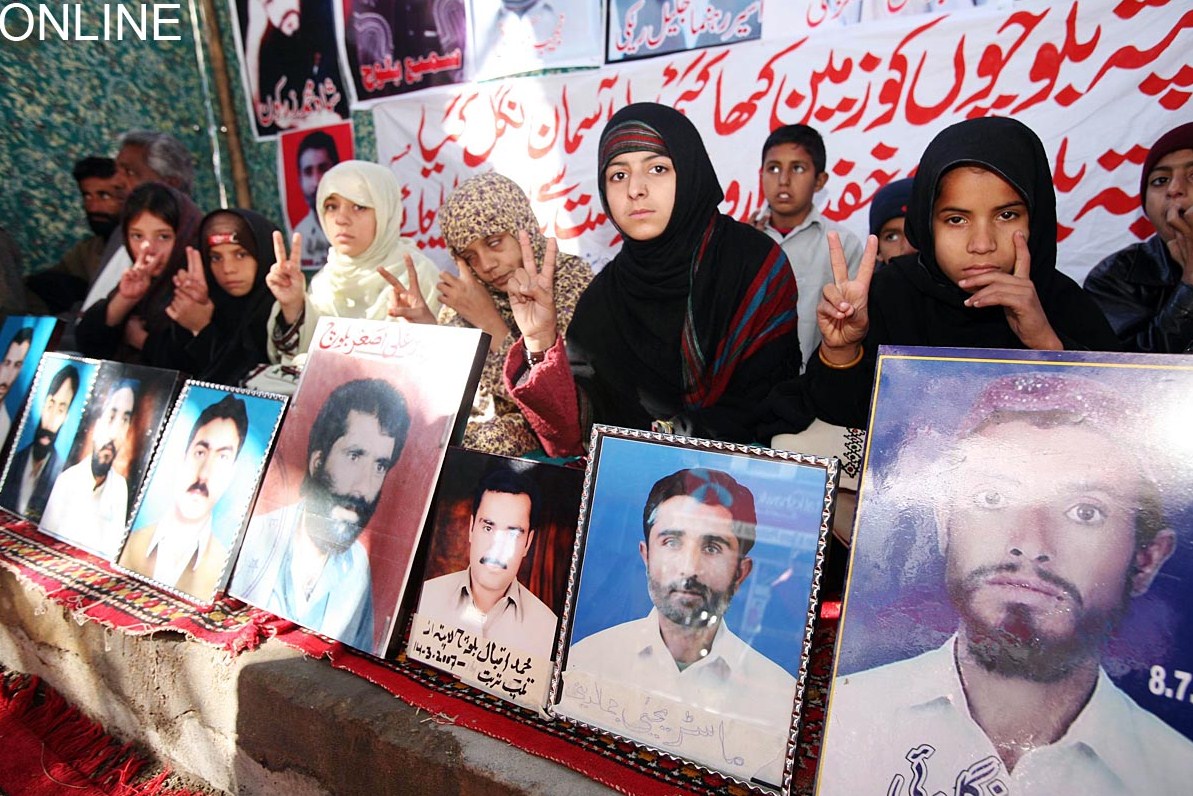
missing-personns-kidsThe current conflict, which started in 2004 as a result of the arbitrary policies of General Musharraf and culminated in the death of Nawab Akbar Bugti, is again a testimony to Islamabad’s flawed approach towards Balochistan. Bugti and other nationalists voiced their concerns regarding ‘mega projects’ in Balochistan announced by Musharraf’s government and vowed to stand up against any development launched without the approval of the Baloch.  Not learning from the mistakes of his predecessors, Musharraf, instead of addressing Baloch grievances politically and through negotiations, adopted an aggressive posture that added fuel to the fire. By killing Bugti – one of those few sardars who voted to join Pakistan in 1947 and who favoured federation – Musharraf committed a great political blunder as the incident sparked an unprecedented wave of anti-Pakistan sentiments that provided great impetus to the Baloch insurgency and the nationalist cause. The new cadre of the Baloch nationalist youth is more rigid and radical in its approach. While Bugti was willing to negotiate with the federal government, his young and radical followers spurn dialogue and coexistence with the federation.

Bugti’s death, combined with the issue of missing persons in Balochistan, has resulted in the unfortunate target killings of settlers – mainly Punjabi workers and teachers – and attacks on government personnel, buildings and installations. The killing of Punjabi teachers, allegedly by Bloch insurgents, has not only caused substantial economic and political damage but has also caused great setbacks to the educational system in the province, already the worst in Pakistan. In the wake of targeted killings, a considerable number of qualified teachers, fearing for their safety, have either left the province or demanded their relocation to schools in Pashtun-dominated districts of Balochistan where the law and order situation is relatively better. Insurgents view schools as representatives of the Pakistani state and symbols of military oppression.

It is worth noting that the victims of target killings are people who settled in the province long ago and have almost integrated themselves into the socio-cultural, economic and political fabric of the province. These people have nothing to do with the state and its military establishment against whom the Baloch anger is directed and such killings have evoked condemnation from almost all the political forces in the province, including Sardar Attaullah Mengal, a veteran Baloch Nationalist leader, who in an interview with the BBC renounced the use of violence to achieve political goals.

The state’s response to the situation has been terrible. Security agencies, instead of improving the law and order situation and providing security to the settlers, have responded with abduction and extra-judicial killings of Baloch political workers and activists, deteriorating the situation further. In a recent and more worrying trend, mutilated and decomposed bodies of abducted Baloch youth and political activists have started turning up along roads in desolate places. Portraying an ‘extremely precarious’ picture of the situation in Balochistan, the Human Rights Commission of Pakistan (HRCP) reported that at least 140 bodies of missing persons have been found in the last 11 months and that there is credible evidence that security forces are involved. The commission also said that all the authority in the province seems to rest with the security forces, who enjoy complete impunity, whereas the civil administration, which is meant to represent the people, appears to have ceded its powers.

The PPP government was off to a positive start when it extended apologies to the Baloch people for past injustices, but it could do little more than make empty promises to resolve the issue. Nevertheless, the passing of the National Finance Commission Award and the abolition of the concurrent list through the 18th amendment were some commendable steps taken by the PPP government. The adoption of the 18th amendment was a great success in particular as it settled the issue of provincial autonomy to the satisfaction of all stakeholders. But these steps have done little to improve the situation in the province – the use of force continues to be the preferred approach in dealing with the insurgency. There has been little improvement in the lives of ordinary people. The provincial government is corrupt. Most importantly, it is subservient to military authorities in the province and, therefore, has no mandate to talk to the insurgents or the aggrieved nationalist leaders. The much-hyped Aghaz-e-Huqooq-e-Balochistan package has also been a disappointment as the government has only been able to implement 15 of its 61 proposals.

Given the grim situation, only a genuine attempt can bring an end to the turmoil. The government must focus on winning the hearts and minds of the traumatized Baloch masses. All possible efforts should be made to make the province’s disillusioned nationalist leaders a part of the mainstream political spectrum; the issue of missing persons should be solved on an urgent basis; and the security forces operating in the province should be brought under civilian control. Furthermore, the powers of the Senate should be enhanced to ensure the real essence of federalism while the concerns of the Baloch regarding their natural resources and the mega-projects must be addressed as well. A clear and comprehensive roadmap should be provided for the socio-economic development of the area before it is too late.

Categories
عکس و صدا

رونقِ دہر میں۔۔۔۔

شیراز اسلم کی فوٹو گرافی

(Published in The Laaltain – Issue 8)

Categories
شاعری

ہم جماعت سے

مجھے افسوس ہے ساتھی
کہ تیری خوش گمانی پر
کبھی پورا نہیں اُترا
ترے انعام و رحمت کا کبھی شاکر نہیں ٹھہرا
مجھے معلوم ہے ساتھی
کہ تیرا قرب پانے کو، بہت سے دل دھڑکتے ہیں
میرے ساتھی ، تمھارا ساتھ پانے کو بہت پہلو بدلتے ہیں
تمھاری سرمگیں آنکھیں کسی جانب جو اٹھتی ہیں
بہت سے ہاتھ اپنے کالروں کو ٹھیک کرتے ہیں
مجھے معلوم ہے ساتھی
تیرے لہجے کی شیرینی شہد خیرات کرتی ہے، دلوں کو موم کرتی ہے
میں خوش ہوں کہ تیری روشن جبیں میرے مقابل ہی چمکتی ہے
تمھاری نرم گفتاری فقط میری ہی قسمت ہے
مجھے معلوم ہے ساتھی
تمھارے ساتھ ہو لوں تو
بہت سے راستے ہموار ہو جائیں
بہت سے بدگماں ساتھی دوبارہ یار ہو جائیں
بہت سے بے یقیں باغی میری بیعت پہ پھر تیار ہو جائیں
مگر ساتھی ، مری ساتھی
میں ایسا کر نہیں سکتا
نہیں ایسا نہیں ہے کہ میں اس جذبے سا خالی ہوں
تجھے کیسے بتاؤں کہ میرے دل میں محبت ہی محبت ہے
مگر میں بے دھیانی میں، یہ جذبہ بانٹ بیٹھا ہوں
میں ایسی نہج پہ ہوں اب
جہاں چاہت کبھی مختص نہیں ہوتی
اور اب میرا یہ عالم ہے
یا یوں کہہ لو میرا یہ مسئلہ ہے کہ
بھلے تجھ پہ ہی مرتا ہوں
مگرا میں نسلِ آدم سے
برابر پیار کرتا ہوں